A Short History of Plantation Shutters
Plantation shutters may look like a modern interior-design feature, but the basic idea behind them is centuries old. Long before glass windows became affordable and widespread, people needed a practical way to protect openings in their homes from wind, rain, heat and glare while still allowing some control over light and ventilation. Over time, simple solid shutters evolved into more refined timber designs and eventually into the adjustable-louvre plantation shutters we recognise today. Their history stretches from the Mediterranean and Europe to colonial North America and Australia, where shutters gradually shifted from being a practical building necessity to a popular architectural and interior-design feature.
In this article
- A brief history of shutters
- Before glass windows became common
- How shutters spread through Europe
- How plantation shutters reached North America
- Where did the name “plantation shutter” come from?
- The arrival of shutters in Australia
- From practical necessity to interior design
- How plantation shutters evolved
- From timber to modern PVC
- What about timber shutters?
- How are plantation shutters used today?
- Light and privacy control
- Temperature and sun control
- Easy maintenance
- Why have plantation shutters lasted so long?
A brief history of shutters
Some of the earliest shutter-like window coverings are commonly associated with ancient Greece and the Mediterranean. Early examples were reportedly made from marble or other solid materials. They were extremely heavy and were generally fixed in position, but they performed an important job: helping protect openings from strong sun, wind and rain while still allowing some light and ventilation into the building.
The Mediterranean climate made this type of window control particularly useful. Homes needed protection from intense sunlight and heat, but completely sealing an opening could make interiors dark and uncomfortable. The basic principle behind shutters — controlling the environment at the window without permanently blocking it — proved useful enough to survive for centuries.
Before glass windows became common
Today we tend to think of glass as an essential part of every window, but for much of European history glass was expensive and difficult to manufacture in large sheets. In medieval Europe, glazed windows were often associated with wealthier homes, churches and important buildings rather than being something every household could afford.
Ordinary homes still needed a way to close window openings against weather, cold and unwanted access. Timber became a practical solution because it was far more accessible than glass and could be shaped into panels that were opened and closed as required.
These early wooden shutters were simpler than modern plantation shutters, but they served many of the same basic purposes: controlling light, improving privacy, limiting exposure to weather and allowing ventilation when needed.
As timber shutter construction became more refined, shutters became increasingly common across Europe. By the Tudor period in England, wooden window shutters were a familiar architectural feature and were often used alongside small areas of glass.
How shutters spread through Europe
As building techniques improved, shutters became more sophisticated. Hinged timber panels could be made stronger, thinner and easier to operate. Decorative details also began to appear, meaning shutters were no longer purely functional.
Different European and Mediterranean regions developed their own shutter styles to suit local climates and architecture. In warmer areas, ventilation was particularly important, encouraging designs that could allow air movement while reducing direct sunlight.
This gradual development helped establish the basic idea that still defines plantation shutters today: a solid framed window covering that gives the occupant control over privacy, airflow and light.
How plantation shutters reached North America
European settlers took familiar building techniques with them when they moved to North America, including the use of timber shutters.
Spanish influence was especially important in warmer southern regions, where shutters suited the climate particularly well. They could help reduce harsh sunlight while still allowing air to move through the home — an important advantage before modern air conditioning.
Timber was also widely available, making shutters a practical and economical way of covering large window openings.
As shutter use became increasingly common in large colonial properties and plantation homes throughout the southern United States, the style became strongly associated with that architecture.
Where did the name “plantation shutter” come from?
The name does not describe where shutters were originally invented. Shutter-like window coverings had already been used in Europe and the Mediterranean for centuries before they became associated with plantations in North America.
Instead, the term developed because wide, louvred timber shutters became a prominent feature in plantation-style homes in the American South.
These homes often had large windows and needed effective control of heat, sunlight and ventilation. Wide adjustable louvres were particularly well suited to that environment because they could be tilted to change the amount and direction of light entering the room.
For the order, over time, the association between this type of louvred shutter and plantation architecture became strong enough that the term “plantation shutter” remained in common use.
The arrival of shutters in Australia
Shutters also travelled to Australia with European settlement.
Early Australian homes had to deal with strong sunlight, heat, wind and exposure to the elements, often in areas where building materials and glazing were limited. Timber shutters offered a straightforward way to cover window openings and create an additional barrier between the interior of the home and the outside environment.
In early cottages and bush buildings, shutters could be far more than a decorative feature. They were a practical part of making a simple building more secure and comfortable.
As Australian towns and cities developed and glass windows became more accessible, shutters gradually became less essential as a primary window covering.
From practical necessity to interior design
The increasing availability of affordable glass changed the role of shutters.
Once windows could be permanently glazed, shutters were no longer required simply to close an opening in a building. Curtains, blinds and other window furnishings also became more common.
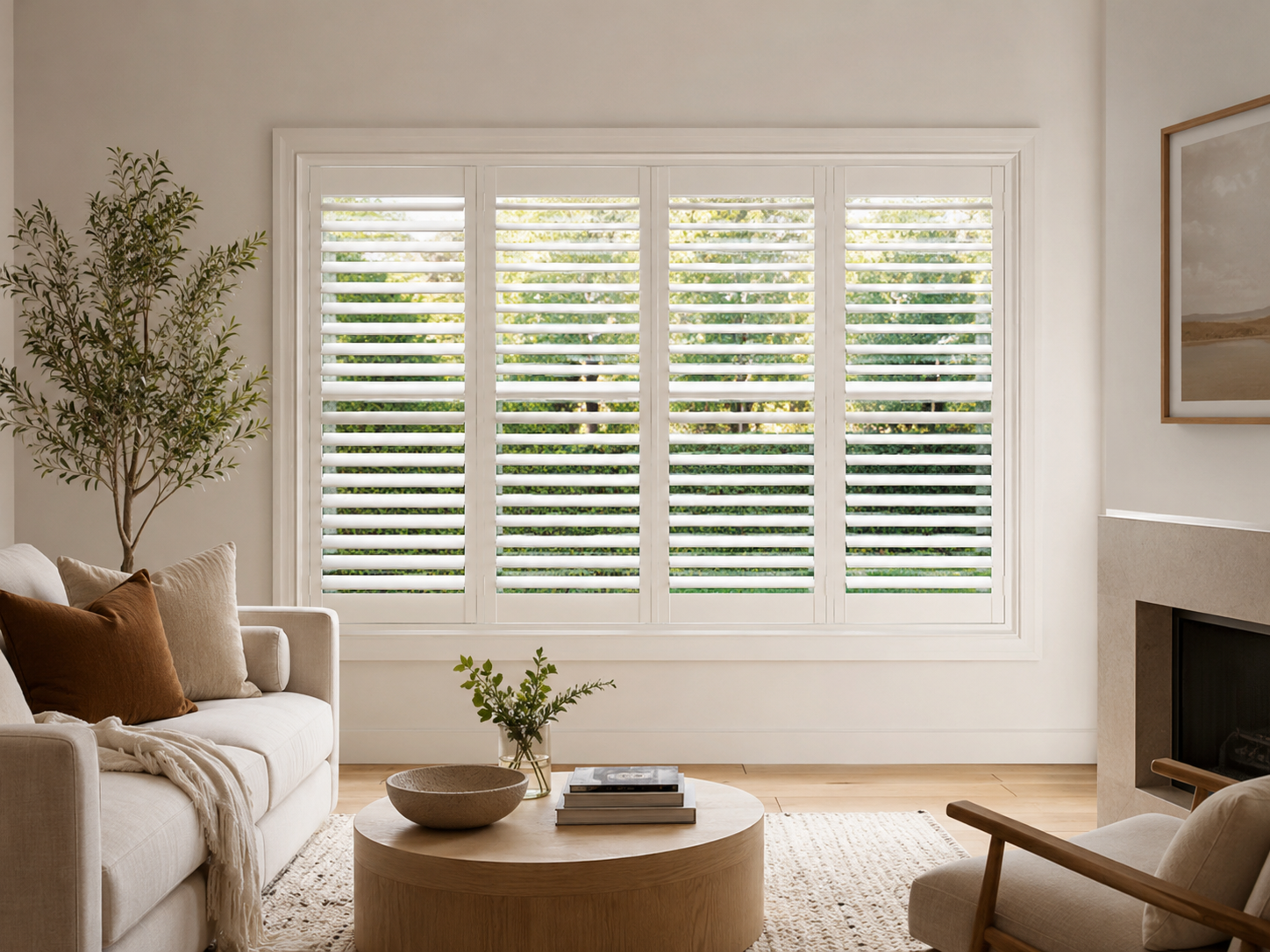
Rather than disappearing altogether, shutters gradually changed from being primarily a building necessity into an architectural and decorative choice.
Their clean lines, framed appearance and ability to control light remained attractive, particularly in homes influenced by colonial and traditional architecture.
By the middle of the twentieth century, renewed interest in colonial-inspired homes helped bring plantation shutters back into fashion. Their appearance worked well with both traditional interiors and newer homes looking for a more substantial alternative to fabric window coverings.
How plantation shutters evolved
Modern plantation shutters are considerably more refined than the heavy fixed shutters used centuries ago.
At this stage, the most obvious development is the adjustable louvre. Rather than simply opening or closing an entire solid panel, modern plantation shutters allow the individual louvres to rotate.
This gives much finer control over the room. The panels can remain closed for privacy while the louvres are tilted to admit light or ventilation. Alternatively, the louvres can be closed to reduce incoming sunlight and increase privacy.
Modern manufacturing has also made shutter components more consistent and precise. Frames, hinges, louvres and panel systems can now be produced specifically for the dimensions and configuration of an individual window.
From timber to modern PVC
Timber remained the traditional plantation-shutter material for generations, and natural timber is still an excellent choice when the visual character of real wood is an important part of the design.
Today, however, shutters can also be manufactured from modern materials such as PVC.
For the order, at Atelier Blinds, our PVC plantation shutters use a tough, waterproof PVC construction with an internal aluminium core. The aluminium reinforcement adds strength and helps reduce the risk of louvres bowing or warping over time.
PVC is particularly practical for kitchens, bathrooms and busy family homes because it is moisture resistant and easy to clean.
For this step, our PVC shutters are designed for interior use only and are not intended for exterior installation outside the home.
What about timber shutters?
Timber still has an important role in modern plantation shutters.
For the order, its biggest advantage is appearance. If you want a stained finish where the natural grain and character of the timber remain visible, genuine timber creates a finish that PVC cannot completely reproduce.
For painted white shutters, however, there is very little visible difference between a quality PVC shutter and a painted timber shutter once installed. Because the timber grain is covered by paint, PVC will generally make more sense for customers who want a white or neutral shutter and place a higher priority on moisture resistance, durability, stability and ease of maintenance.
Unless the natural stained-timber look is an important part of your interior design, aluminium-reinforced PVC is typically the more practical choice.
How are plantation shutters used today?
Modern plantation shutters combine many of the practical ideas that made shutters useful historically with the clean appearance expected from a modern window furnishing.
The adjustable louvres allow you to change the balance between privacy and natural light throughout the day. The shutter panels can remain closed while the louvres are opened, helping maintain privacy without making the room completely dark.
Opening the window behind the shutter can also allow ventilation while the shutters remain in place.
When more light is wanted, the louvres can be opened fully or the shutter panels themselves can be swung away from the window.
Light and privacy control
One reason plantation shutters have remained popular for so long is the amount of control they provide.
With a curtain, the choice is often largely open or closed. A plantation shutter provides an additional level of adjustment because the angle of the louvres can be changed without opening the entire panel.
Louvres can be tilted upward or downward to reduce direct views into the room while still allowing daylight to enter.
This is particularly useful for street-facing bedrooms, living areas and bathrooms where privacy is important during the day.
Temperature and sun control
Windows can be a weak point in the thermal performance of a home because sunlight and heat can pass through glass relatively easily.
Plantation shutters add another substantial layer over the inside of the window. Closing the louvres can help reduce direct sunlight entering the room during hot periods, while the shutter itself creates an additional layer between the room and the glass.
During cooler weather, keeping shutters closed can also help reduce the direct exposure of the room to the cold window surface.
Plantation shutters are not a replacement for proper glazing or insulation, but their ability to control direct sunlight and add another layer at the window can contribute to a more comfortable interior.
Easy maintenance
Modern plantation shutters are also popular because they are relatively simple to maintain.
Unlike fabric window furnishings that may absorb dust or require more involved cleaning, PVC shutters can generally be wiped clean with a soft cloth.
Their smooth surfaces are particularly useful in kitchens, bathrooms and homes with children or pets.
Keeping the louvres and frame clean also helps preserve the crisp architectural appearance that makes plantation shutters distinctive.
Why have plantation shutters lasted so long?
The materials and manufacturing methods have changed enormously, but the fundamental reasons people use shutters have remained remarkably consistent.
Centuries ago, shutters helped people control weather, sunlight, ventilation and privacy at a window opening.
Modern plantation shutters still perform many of those same functions, but they now do so with adjustable louvres, precision-made frames and modern materials.
Their long history is a good demonstration of why the basic shutter concept has endured. It is simple, practical and adaptable, while also creating a strong architectural feature inside the home.
At this stage, plantation shutters have evolved from heavy fixed coverings into a refined modern window furnishing, but the principle behind them remains much the same: giving you greater control over what happens at the window.
Ready to configure your shutters?
Once the measurements and configuration are confirmed, continue to the relevant product page.