Choosing a Plantation Shutter Frame: Complete Guide
Choosing the right plantation-shutter frame starts with understanding your window, the available recess depth and whether the shutter will sit inside or outside the opening. Atelier Blinds offers different frame profiles for inside and outside mounting, and the best choice depends on clearance, architraves, sills and window hardware.
In this article
- What is a shutter frame?
- Inside vs outside mount
- What is a Z-frame?
- Can I install a Z-frame with an architrave?
- Can I install a Z-frame with a window sill?
- As you work through the guide, can I install a Z-frame with an architrave and window sill?
- Installing a Z-frame with obstructions
- What is an L-frame?
- What is an inside mount L-frame?
- Can I install an L-frame with an architrave?
- Can I install an inside L-frame with a window sill?
- At this stage, can I install an inside L-frame with an architrave and window sill?
- What is an outside mount L-frame?
What is a shutter frame?
The shutter frame is the fixed perimeter that is secured to the window opening. Your shutter panels then hinge into this frame, so it controls where the panels sit, how far they project into the room and how the finished shutter meets the wall, recess or architrave.
The frame also helps create a neat transition around the opening and can disguise small variations in the window edges.

Inside vs outside mount
At this stage, there are two main ways to position plantation shutters: inside mount (recess fit) and outside mount (face fit).
An inside mount sits within the window recess. An outside mount sits on the face of the architrave or wall surrounding the opening. Inside mounting generally gives a more recessed appearance and uses a slightly smaller overall shutter, while outside mounting is useful when the recess is too shallow or contains obstructions.

As you work through the guide, for inside mounting, the frame can typically be either a Z-frame or an inside L-frame. Outside mounting uses the outside L-frame profile.

How do I know if I should inside or outside mount?
For this step, start by checking the usable depth of the recess. As a general guide, around 70 mm of clear depth gives the louvres and shutter components room to operate without hitting handles, winders, locks, flyscreens or the glass.
Do not measure the recess depth alone. Run the tape from the front edge of the recess to the furthest obstruction because that is the space the shutter can actually use.

If you’re unsure which mounting option is right for your window, look at our guides first, and if you’re still unsure? Upload photos through the website contact form and we will review them for you. Where a Z-frame is suitable, we suggest using one as it helps minimise light gaps around the shutter and helps to accommodate for out of square windows. Outside face-fit shutters sit in front of the window opening and therefore project further into the room.
What is a Z-frame?
A Z-frame is an inside-mount frame with one section sitting within the recess and a front lip overlapping the edge of the opening. The overlap creates a crisp finished border and can help hide small gaps or minor inconsistencies around the recess.

How does a Z-frame mount to my window?
For this step, the Z-frame fixes into the window recess while its front lip returns over the front edge. Check the dimensions shown in our current frame-profile diagram when confirming your final recess and architrave clearances. A Z-frame requires a clear depth of at least 60mm.
You also need sufficient usable depth behind the frame for the louvres to rotate without striking the glass or window hardware.
For the order, have more questions about Inside Z-frames? Read our detailed Inside Z-Frame guide for everything you need to know about how they work, when to use them and installation requirements.


Can I install a Z-frame with an architrave?
Yes, provided the shutter can be inside mounted and there is enough flat surface around the opening for the Z-frame lip to sit neatly. A square or gently rounded architrave is generally straightforward.
If your architrave is heavily decorative, check where the lip will land before selecting the Z-frame so it does not cover a detail you want to keep visible.

Can I install a Z-frame with a protruding window sill?
Yes. Where a sill projects into the room, the bottom frame section can be configured to sit neatly on top of the sill rather than trying to wrap around it. You will need to select the relevant option on the product ordering page if this is the case, and we will make your shutter with an L-frame on the bottom section.

Can I install a Z-frame with an architrave and window sill?
Yes, as long as the window still has suitable inside-mount clearance and the frame has a flat surface to finish against. The side and top sections can use the Z-frame profile while the bottom is arranged to finish cleanly at the sill.

Installing a Z-frame with obstructions
As you work through the guide, while we state that you will require 60mm of clearance depth for a Z-frame – Handles, winders, locks and flyscreens do not automatically rule out a Z-frame. Their exact location matters. Hardware close to the outer edge may affect the frame itself, while hardware further into the opening may affect the louvres or rails.
For this step, measure the clearance carefully and refer to our Handles, Winders & Other Shutter Obstructions guide before finalising the mount.
At this stage, want to use an Inside Z-frame but don’t have the full 60 mm of clearance depth? Read our Managing Window Obstructions guide — depending on the position of your handles, locks or winders, an Inside Z-frame may still be possible.

What is an L-frame?
An L-frame has an L-shaped cross-section. We use different L-frame profiles depending on whether the shutter is mounted inside the recess or onto the face of the wall or architrave.
An inside L-frame keeps the frame within the recess. An outside L-frame moves the entire shutter forward and will therefore project further into the room.


What is an inside mount L-frame?
An inside L-frame fixes inside the window recess without the overlapping front lip of a Z-frame. It can sit close to the front of the recess or, where there is additional depth, be positioned further back.
This can be a very clean option where you want to keep a decorative architrave fully visible.

How does an inside L-frame mount to my window?
The inside L-frame requires enough clear recess depth of 70mm for both the frame and the operating shutter blades to open fully. Confirm the exact current profile dimensions shown in our frame diagram and confirm the selected position remains clear of handles, locks, flyscreens and opening sashes.
As you work through the guide, have more questions about Inside L-frames? Read our detailed Inside L-Frame guide for more information.

Can I install an L-frame with an architrave?
Yes. Because an inside L-frame remains inside the recess, it can work particularly well where the architrave is decorative and you do not want the shutter frame covering the front of the trim. Although keep in mind that you will have light gaps around your frame and out of square windows may exaggerate these gaps. If this is an issue for you, please consider Z-frames.
At this stage, if you have an architrave and are unsure whether an Inside L-frame will be suitable, upload a photo of your window through our website contact page and we will review it and recommend the best mounting option.

Can I install an inside L-frame with a window sill?
Yes. The frame can sit inside the recess and finish on top of the sill at the bottom of the opening.
Can I install an inside L-frame with an architrave and window sill?
Yes, provided you have enough usable recess depth for an inside mount. This arrangement keeps the architrave visible while allowing the bottom of the shutter frame to finish at the sill.
For this step, still unsure whether to inside or outside mount your shutters? Read our Inside vs Outside Mount Plantation Shutters guide, or upload a photo of your window through our website and we will recommend the most suitable option.
Installing a L-frame with obstructions
At this stage, while we state that you will require 70mm of clearance depth for a L-frame – Handles, winders, locks and flyscreens do not automatically rule out a L-frame. Their exact location matters. Hardware close to the outer edge may affect the frame itself, while hardware further into the opening may affect the louvres or rails.
Measure the clearance carefully and refer to our Handles, Winders & Other Shutter Obstructions guide before finalising the mount.
As you work through the guide, want to use an Inside L-frame but don’t have the full 70 mm of clearance depth? Read our Managing Window Obstructions guide — depending on the position of your handles, locks or winders, an Inside L-frame may still be possible.
What is an outside mount L-frame?
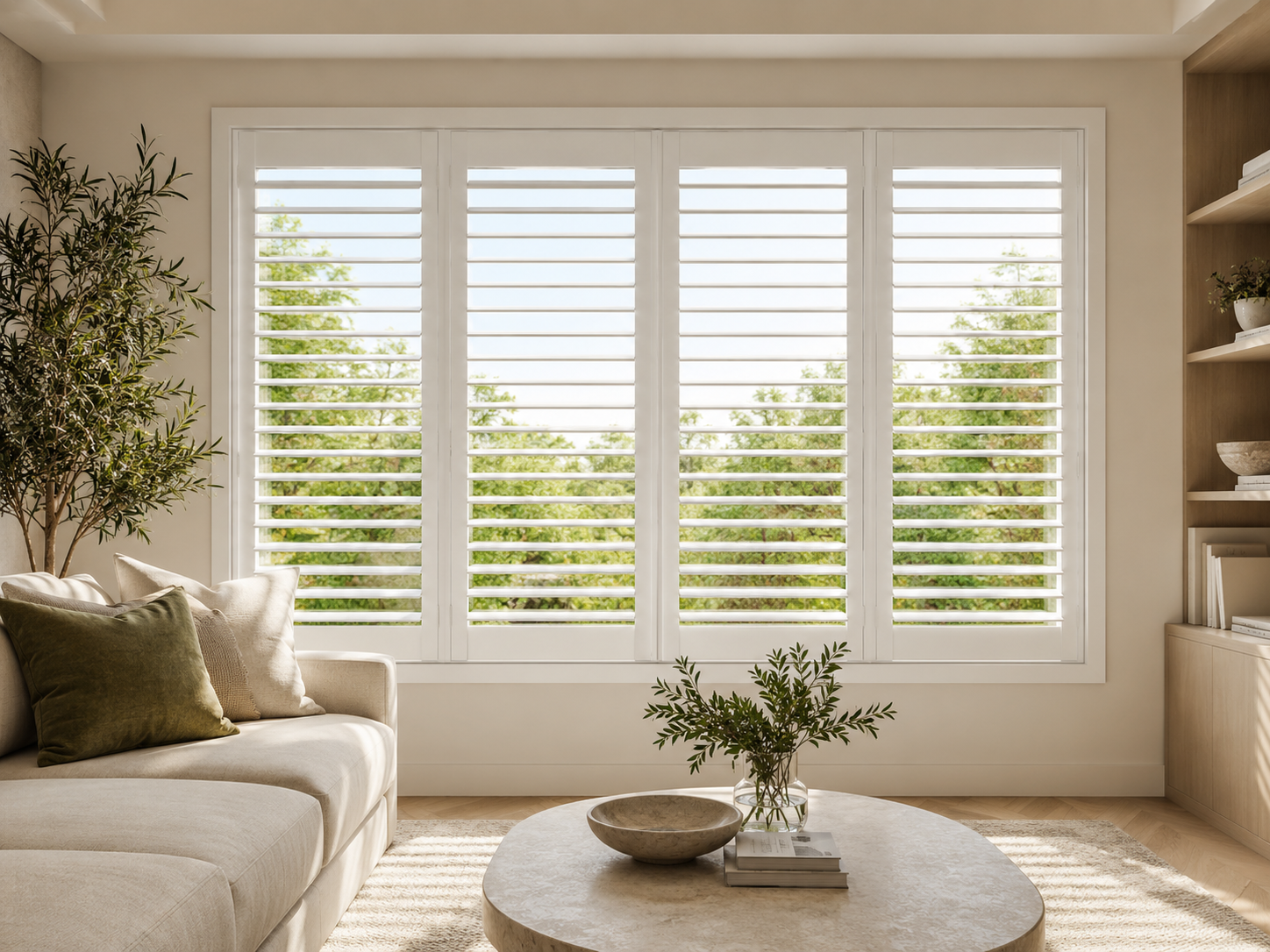
An outside L-frame is fixed to the face of the architrave or directly to the wall around the opening. It is often the best option when the window does not have enough clear recess depth for an inside mount.
Because the shutter sits in front of the opening rather than inside it, an outside mount projects further into the room by approximately 65mm and the overall shutter is slightly larger.
How does an outside L-frame mount to my window?
The outside L-frame needs a continuous flat fixing surface around the opening. On a square or bullnose architrave this is normally easy to identify. With decorative trim, confirm there is a sufficiently flat section for secure fixing.
As you work through the guide, you will need at least 38 mm of flat surface around the outside of the window opening to securely install an outside-mounted shutter.
For square-set windows without architraves, the frame can be fixed to the wall face around the recess.


Ready to configure your shutters?
Once the measurements and configuration are confirmed, continue to the relevant product page.