Shutters or Blinds? Choosing the Right Finish
Both plantation shutters and blinds can transform the look and function of a room, but they do it in very different ways. Blinds are generally the more economical option upfront and offer enormous flexibility in colours, fabrics and styles. Plantation shutters cost more initially, but provide a more permanent architectural finish, excellent light and privacy control, easy maintenance and a long service life. The right choice comes down to your budget, the room, how you want to control light and privacy, and the look you want to achieve.
In this article
- Plantation shutters
- Longevity
- Cost and long-term value
- Cleaning and maintenance
- Light control
- Privacy
- Style
- Blinds
- Upfront cost
- Privacy and light control with blinds
- Home decor and fabric choice
- Versatility
- Maintenance
- Which is better for bathrooms and kitchens?
- Which is better for bedrooms?
- Which is better for large windows and sliding doors?
- The verdict
Plantation shutters
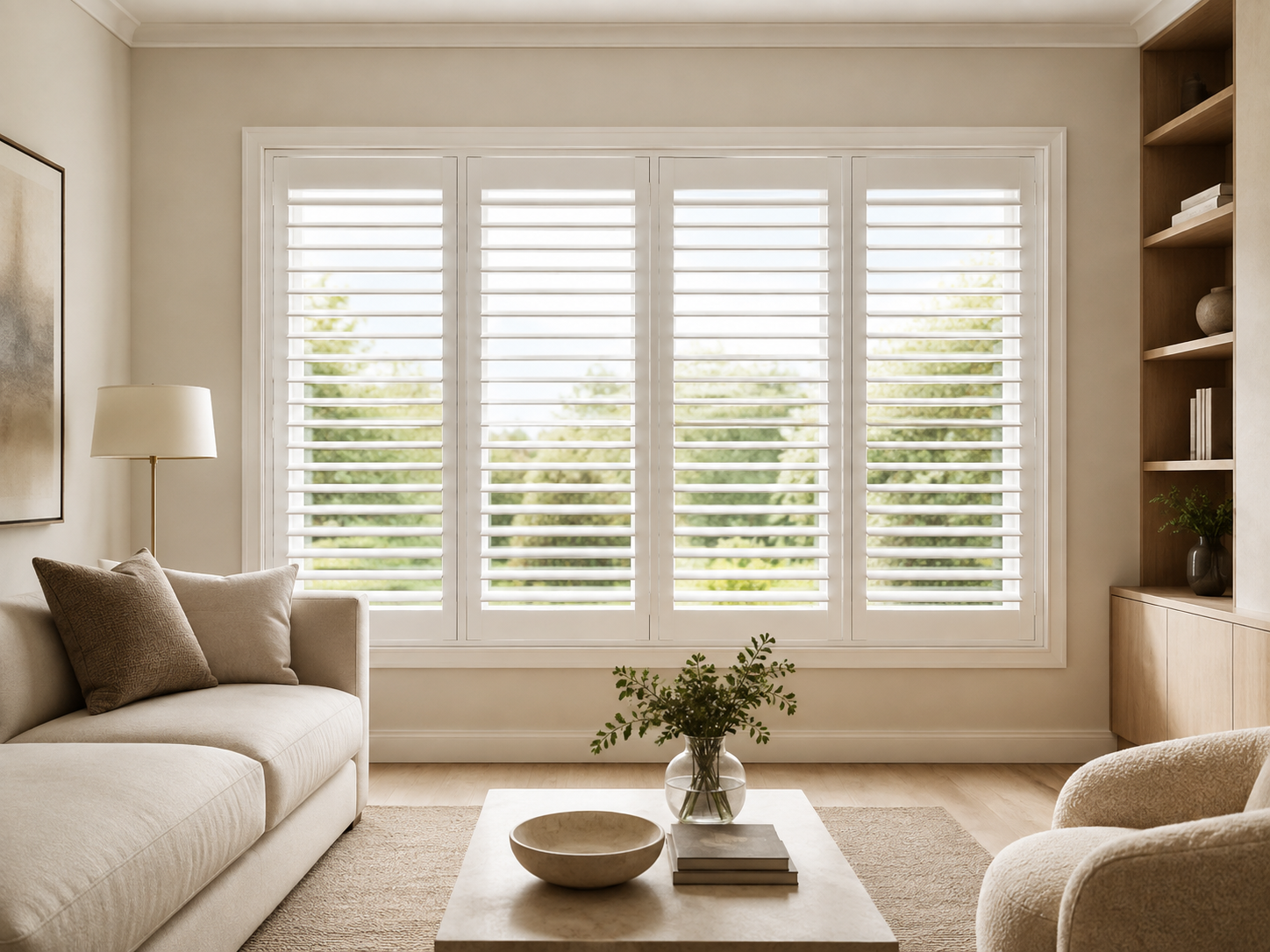
Plantation shutters are a framed window treatment made from hinged panels containing adjustable louvres. Unlike a blind that hangs in front of the glass, shutters become a much more substantial visual part of the window itself.
They suit customers looking for a clean architectural finish, fine control over light and privacy, easy maintenance and a product intended to remain in place for many years.
Longevity
Plantation shutters are designed to become a long-term part of the window rather than a soft furnishing that may be replaced as trends change.
For this step, our PVC plantation shutters use a tough waterproof PVC construction with internal aluminium reinforcement to add strength and help resist bowing. That makes them particularly practical for busy family homes and moisture-prone interior areas such as kitchens and bathrooms.
At this stage, pVC shutters are intended for interior use only and are not suitable for exterior installation outside the home.
Cost and long-term value
Plantation shutters generally cost more than blinds at the initial purchase stage, but the comparison should not stop there.
A quality shutter is designed to remain in place for many years. The solid frame, hinged panels and adjustable louvres create a substantial finished product that can become part of the architecture of the room.
Shutters can also add another layer between the room and the glass. Closing the louvres can help reduce direct sunlight entering the room and can assist with privacy and comfort throughout the day.
For customers who want a permanent window treatment rather than the lowest upfront price, shutters can represent strong long-term value.
Cleaning and maintenance
One of the biggest practical advantages of shutters is how easy they are to maintain.
PVC louvres and frames can generally be dusted or wiped clean with a soft damp cloth. There is no fabric to remove, wash or send away for cleaning, and the waterproof surface makes PVC particularly easy to look after in kitchens and bathrooms.
Light control
Plantation shutters provide excellent control over natural light.
The louvres can be tilted gradually rather than simply being fully open or fully closed. This lets you reduce glare, direct light away from the room, maintain privacy or allow more daylight inside without necessarily opening the shutter panels themselves.
For maximum light, the louvres can be opened fully or the panels can be swung away from the window.
Privacy
Shutters are particularly useful when you want daylight and privacy at the same time.
The panels can remain closed while the louvres are angled to make it harder to see directly into the room. This can work especially well on street-facing windows, bedrooms, bathrooms and living areas.
Style
Plantation shutters create a much more architectural appearance than most blinds.
The framed panels become a visible part of the window and suit a wide range of interiors, from traditional and coastal homes through to clean modern spaces.
For painted white shutters, aluminium-reinforced PVC is usually the practical choice. If you specifically want a stained natural timber finish with visible grain, timber shutters are available for that more traditional look.
Blinds
Blinds are generally the more economical and flexible window-covering option. They are available in an enormous range of fabrics, colours, opacity levels and operating styles and can work on everything from small bedroom windows to large sliding doors.
They are particularly useful when the priority is a lower upfront cost, strong blockout performance or a window treatment that takes up very little space.
Upfront cost
Blinds are generally more affordable than plantation shutters at the initial purchase stage, which makes them attractive when budget is the main priority or when you have a large number of windows to cover.
Roller blinds in particular can provide a very cost-effective way to achieve privacy, light control or blockout without the higher material and manufacturing cost of a framed shutter system.
Privacy and light control with blinds
Blinds can provide excellent privacy, particularly when a blockout fabric is used.
Depending on the blind type and fabric, they can also be used to reduce glare, filter daylight or darken a bedroom. Dual roller-blind systems can combine a sunscreen or light-filtering blind with a separate blockout blind, giving you more flexibility throughout the day.
Home decor and fabric choice
One of the biggest advantages of blinds is variety.
They are available in a huge range of colours, textures, fabrics and opacity levels, making it easy to coordinate them with flooring, paint colours, furniture and other soft furnishings.
A blind can also visually disappear into the room more easily than a plantation shutter if you want a very minimal window treatment.
Versatility
Blinds can be fitted to an enormous range of windows and doors.
Roller blinds work particularly well on standard windows, large openings and sliding doors where a hinged plantation-shutter panel may not be the most convenient solution.
They can also be configured as recess fit or face fit depending on the available space and the level of light coverage required.
Maintenance
Blinds are relatively simple to use, but cleaning depends heavily on the material.
Smooth roller-blind fabrics can often be dusted or spot cleaned, while some decorative fabrics require more care. Compared with PVC shutters, fabric blinds can also hold more dust and may eventually show wear, creasing or staining depending on the environment.
Which is better for bathrooms and kitchens?
For moisture-prone interior areas, aluminium-reinforced PVC shutters have a strong advantage because the PVC itself is waterproof and easy to wipe clean.
Blinds can also be used in kitchens and bathrooms, but the selected fabric and components need to be suitable for the environment.
If you want a substantial, easy-clean window treatment in a wet area, PVC shutters are difficult to beat.
Which is better for bedrooms?
It depends on what matters most.
A blockout roller blind is usually the better choice if your main objective is maximum room darkening for the lowest cost.
Plantation shutters provide excellent light control and privacy, but small amounts of light can still pass around or between shutter components. They should not be treated as a completely light-sealed product.
For customers who value the architectural appearance of shutters but want the darkest possible bedroom, shutters can also be combined with another window treatment where appropriate.
Which is better for large windows and sliding doors?
For very large openings and sliding doors, blinds can often be simpler and more economical.
Roller blinds take up relatively little space and do not require hinged panels to swing into the room.
Shutters can still be used on larger openings with the correct panel layout, but the way the panels open, stack and interact with furniture needs to be considered before placing the order.
The verdict
There is no single answer for every room.
At this stage, choose plantation shutters if you want a more permanent architectural finish, excellent adjustable light and privacy control, easy cleaning and the durability of aluminium-reinforced waterproof PVC.
For the order, choose blinds if your priority is a lower upfront price, a huge choice of fabrics and colours, strong blockout options or a simple solution for very large windows and sliding doors.
Many homes use both. Shutters can be the feature window treatment in living areas, kitchens, bathrooms and street-facing rooms, while roller blinds can provide a practical and economical solution elsewhere.
The best option is the one that suits the window, the room and how you actually use the space.
Ready to configure your shutters?
Once the measurements and configuration are confirmed, continue to the relevant product page.